
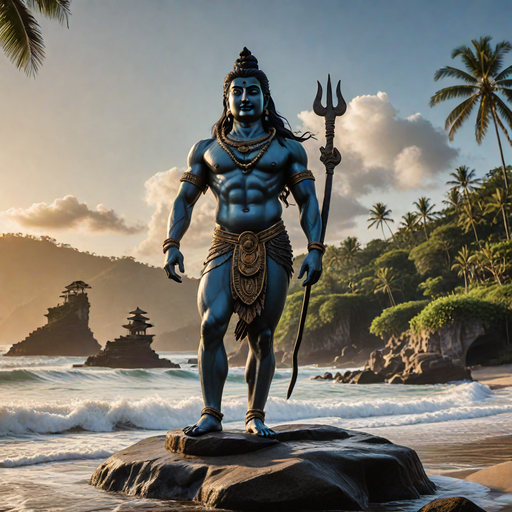

Bali, the “Island of the Gods,” has long been a place of spiritual significance and mythological wonder. Known for its verdant landscapes, tranquil beaches, and deeply rooted cultural traditions, Bali is now undergoing a rapid transformation, particularly in its construction sector. Towering resorts, luxury villas, and modern infrastructures are emerging across the island, making it a focal point for both tourism and spiritual reflection (Straits Times, 2024). Interestingly, the dramatic shifts happening in Bali today can be seen as a modern reflection of the ancient mythological tales found in texts like the Shiva Purana, where cosmic battles and transformations mirror the societal changes taking place on the island (Dalal, 2014).
One particularly captivating story within the Shiva Purana is that of Andhaka, the asura (demon) who commands his general, Mahabali, to swallow the gods. This tale of cosmic conflict serves as an allegory for the cyclical nature of creation and destruction, themes that are increasingly resonant as Bali faces rapid urbanization and globalization (Saraswati, 2000).
The Battle of Andhaka and the Gods
In the Shiva Purana, Andhaka’s rise to power as a demon king challenges the gods and the cosmic order. His command to Mahabali to “swallow the gods” is a symbolic act of domination, one that aims to suppress divine forces and reassert the might of the asuras. The gods, however, are not easily subdued. Shiva, the great god of destruction and transformation, responds by throwing his weapons toward Mahabali’s stomach, causing the swallowed gods to be disgorged.
This dramatic moment highlights the delicate balance between creation and destruction that governs both the universe and human existence. Just as Mahabali’s stomach becomes a battleground for the gods’ freedom, Bali’s transformation today is seen as a conflict between modern development and the preservation of its spiritual essence. As luxurious resorts and modern infrastructures replace traditional rice paddies and sacred sites, one wonders how the balance between progress and tradition will play out.

The Cosmic Dance of Shiva and Andhaka
But the story does not end with the liberation of the gods. Enraged by his failure, Andhaka sets his sights on Indra, the king of the gods, hoping to swallow him next. However, Indra manages to escape, a clear sign that even in the face of overwhelming forces, the divine will ultimately prevail.
In retaliation, Shiva, in a move of cosmic justice, swallows Shukra, the guru of the asuras, also known as the embodiment of darkness and deception. This act of swallowing Shukra can be seen as a cosmic purification, a swallowing of darkness by light. The parallels to the transformations occurring in Bali are striking. The rapid growth of the island’s construction sector might seem like a form of “swallowing” the old world, but in doing so, it is forced to reconcile with its spiritual core, where forces of light and darkness clash and ultimately seek harmony.
The Role of the Holy Spirit and Shukra in Christian Context
The tale of Shiva and Shukra has profound connections to other spiritual traditions as well. Through comparative mythology, Shiva is often understood as a Hindu representation of the Holy Spirit of Christianity, the divine force that brings both destruction and renewal (Ascended Master Encyclopedia, n.d.) (Chananda, n.d.). Shukra, on the other hand, can be seen as an embodiment of Lucifer, the fallen angel associated with bringing knowledge of good and evil to humanity. Of course, they’re both associated with the morning star that is Venus.
Recently, the Pope performed a Jubilee ritual in which he symbolically released Lucifer from his tomb (Vice, 2023). This dramatic act can be interpreted as a moment of spiritual reckoning—a surrendering of darkness into the light, allowing the Holy Spirit (Shiva) to transform it. Much like how Shiva swallows Shukra in the myth, this gesture suggests that the forces of darkness and chaos will eventually be reconciled and purified by divine will, leading to a rapid spiritual transformation for humanity.
There are multiple scholars who are quick to dismiss such claim that the Pope is opening the tomb of a spiritual Lucifer, with the reasoning that he’s actually opening the tomb of Lucifer, who happens to be just another Roman individual. This, of course, is happening due to moral outrage from the Christian public. Particularly, from the United States of America, once-free evangelical kleptocracy. Even if it’s just an individual, there’s no doubting that the Helel ben Shahar of Jewish mythology is Christianized into Lucifer due to the Hellenistic association to Prometheus.

Bali as a Reflection of Cosmic Transformation
As Bali continues its transformation, the island becomes a symbolic microcosm of the larger cosmic battle between creation and destruction, light and darkness. The rapid construction projects happening across Bali could be seen as a reflection of the larger forces at play in the universe, where new forms of existence are being built, while old structures are torn down. The mythology of Shiva, Andhaka, and their cosmic struggle is deeply entwined with this process of transformation.
Much like the story of Andhaka’s defeat, Bali’s future will depend on how it balances modernization with spiritual preservation. The island’s construction boom may appear as a victory of modernity, but like Shiva’s triumph over Andhaka, it must ultimately submit to the divine order—the harmonious integration of both progress and tradition, material and spiritual, light and darkness.
The Final Victory of Shiva: A Hope for Bali’s Future
Ultimately, the story in the Shiva Purana culminates with Shiva’s victory over Andhaka, and Andhaka’s submission to the Trimurti’s (the threefold godhead) rule over the asuras. This resolution of conflict is not the end of the story, but rather the beginning of a new order, a new balance between creation and destruction, order and chaos.
For Bali, the rapid transformations of today may be challenging traditional ways of life, but they also present an opportunity for a new spiritual and cultural synthesis. Just as Shiva restores balance in the cosmic world, the island has the potential to integrate its rich spiritual heritage with modern development, creating a harmonious future that honors both its divine past and its evolving present.
As the story of Andhaka teaches us, no force—whether divine or demonic—can ultimately resist the transformative power of divine will. Just as Shiva triumphs over Andhaka, Bali will find its own path of balance, and in this reconciliation, a rapid transformation may emerge, bringing new prosperity while preserving the spiritual essence of the island.
In this way, Bali’s current transformation can be seen as both a reflection of ancient myth and a modern manifestation of the cosmic forces that govern all existence—where light overcomes darkness, and harmony emerges from chaos.
Source:
Straits Times (2024), Balinese Hope Construction Freeze Can Tame Tourism, The Straits Times, https://www.straitstimes.com/asia/se-asia/balinese-hope-construction-freeze-can-tame-tourism.
Dalal, Rosen (2014), Hinduism: An Alphabetical Guide, Penguin, ISBN 978-8184752779
Saraswati, S. (2000), Shiva Purana, Moti Lal Banarsidass Publishers, ISBN 978-8120801244
Ascended Master Encyclopedia (n.d.), Shiva, https://ascendedmasterencyclopedia.org/w/Shiva.
Chananda (n.d.), Trinity: Brahma, Vishnu, Shiva, https://chananda.org/teachings/trinity-brahma-vishnu-shiva/.
Vice (2023), Pope Opening 5 Portals Christmas Eve, Vice, https://www.vice.com/en/article/pope-opening-5-portals-christmas-eve/.
Leave a Reply